

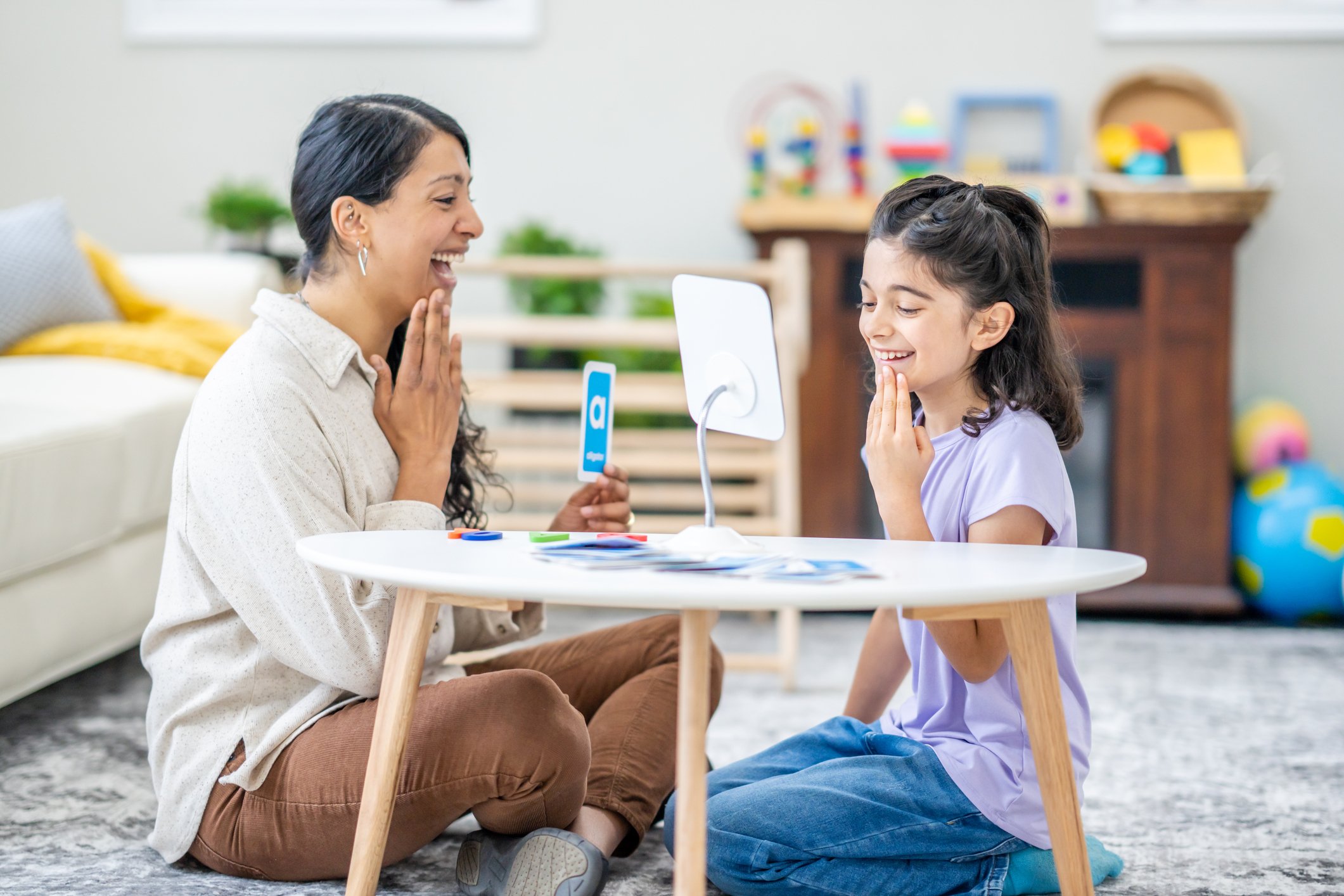
It’s perfectly normal for little ones to get stuck mid-sentence as they search for the right words. This is a natural part of language development, and most children become more fluent and confident communicators with every passing year.
But if your child continues to have difficulty finding words, forming sounds correctly, and is often hard to understand, there may be something more going on. It may be a sign of childhood apraxia of speech, a speech disorder that disrupts the connection between what your child’s brain wants to say and their ability to physically say it.
The good news is that with early intervention with a qualified speech-language pathologist, children with apraxia can improve their ability to express themselves clearly and confidently.
What Are the Signs of Childhood Apraxia of Speech?
For a child with apraxia, the lips, tongue, and jaw are strong, but they just can’t get them to work together to form the right sounds or say words. As a result, your child may feel frustrated because they know what they want to say, but their body isn’t cooperating. The outcome is speech that can sound incorrect, inconsistent, or unclear.
There are many possible reasons why a child might have apraxia, such as genetic factors, neurological differences, or other developmental conditions, but in some cases, there is no identifiable cause at all.
Apraxia can sometimes be mistaken for a more common speech delay because of overlapping symptoms. The signs vary by age and can be as follows:
Early Signs of Apraxia (Around 7–18 months)
- Babbling less or making fewer sounds than expected for their age
- Saying first words later than 12 to 18 months
Signs of Apraxia in Toddlers and Preschoolers (Ages 2–4 years)
- Having trouble saying simple words properly or consistently
- Pausing or stumbling between syllables or words
- Distorting vowel sounds or substituting one sound for another
- Using equal emphasis on all syllables instead of a natural rhythm
- Moving their mouth awkwardly as they try to form a word (sometimes described as “groping” for sounds)
- Making different errors each time they try to say the same word
Signs of Apraxia in School-Age Children (Ages 5 and up)
- Struggling with longer or more complex words
- Speaking slowly because forming words takes extra effort
- Avoiding certain words or becoming frustrated when not understood
- Continuing to distort or substitute sounds after receiving speech therapy to address other concerns
If you notice these patterns in your child, it’s worth getting them evaluated by a speech therapist with experience treating children with apraxia.
Why Speech Therapy Is Essential for Children with Apraxia of Speech
Because apraxia affects how the brain plans and sequences the movements needed for speech, it’s essential that your child works with a pediatric speech therapist who can help strengthen the connection between the brain and the complex motor planning required for speech.
It’s also important to remember that apraxia can sometimes be missed or misdiagnosed by general practitioners or pediatricians. You know your child better than anyone, and if something doesn’t feel quite right or you believe a diagnosis has been overlooked, trust your instincts and get the clarity your child deserves by seeking a qualified speech therapist.
What Speech Therapy Looks Like for Children with Apraxia of Speech
Every child with apraxia is unique, so speech therapy is carefully designed to meet their specific needs. Most treatment plans include the following core elements that support clear, consistent communication:
- Repeating key sounds and words many times to help the brain and muscles remember the right movements for speech. For example, your child might practice saying “ball” or “go” in short, focused bursts until those words become easier to say.
- Using visual, verbal, and light touch cues on your child’s chin or jaw to help them see, hear, and feel how to form sounds correctly. A speech therapist might point to their own mouth while modeling a sound or gently touch your child’s chin to guide movement.
- Choosing target words that are personal and meaningful, like a favorite toy or sibling’s name, and practicing them often to help your child learn to say the words clearly. These words are meaningful motivators that make practice more engaging.
- Holding short, regular sessions to keep learning focused and reinforce progress over time. Many children do best with several shorter sessions each week rather than one long one.
Ways to Support Your Child at Home
Working with your child between sessions is just as important as their time with their speech therapist. Reinforcing what they’re learning in therapy doesn’t have to feel like homework, and there are plenty of fun ways to build practice into your day.
- Use your child’s target words during everyday routines like snack time, bath time, or getting dressed, and have them repeat the words back to you in short, playful bursts.
- Speak slowly and clearly so your child can watch how your mouth moves, making it easier for them to copy you.
- Focus on effort, not results. Praise each attempt to keep your child motivated and confident.
- Add rhymes or songs to make practice engaging. Singing silly phrases or setting target words to a tune can make repetition feel like play.
- Let your child lead conversations and talk about what excites them. When speech practice centers on topics they love, it feels less like therapy and more like connection.
By weaving speech goals into your child’s daily rhythm, you’re helping them make steady progress without it feeling like work.
Reach Out to Gigi’s Kids for Support
The speech therapists at Gigi’s Kids Speech & Language Therapy have the expertise to treat apraxia of speech and can incorporate Augmentative and Alternative Communication (AAC) methods and devices when needed to support your child’s progress. Call us at (248) 735-8080 or fill out our online form to schedule an evaluation. Together, we’ll help your child build clear, confident communication skills that last a lifetime.
Author
Amanda G. Tompkins, MS, CCC-SLP is the founder and owner of Gigi’s Kids Speech & Language Therapy and has been certified by the American Speech and Hearing Association (ASHA) since 2000. With over 25 years of pediatric experience, she has worked extensively in the Bloomfield Hills Schools Deaf and Hard of Hearing program and led a speech therapy department at a center affiliated with autism services. Amanda holds the ASHA Award for Continuing Education (ACE) and continues to share her expertise through trainings for preschools, parent groups, and educators.